
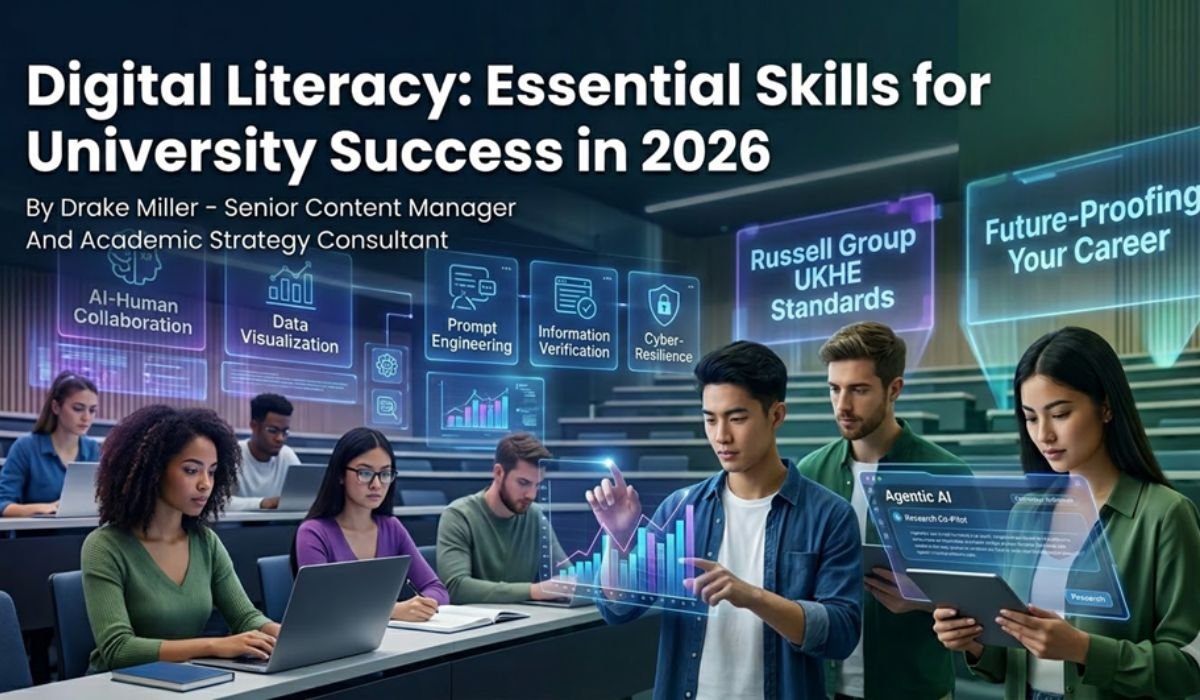
By Drake Miller – Senior Content Manager And Academic Strategy Consultant
The transition from high school to university has always been a significant leap, but as we move through 2026, that gap is no longer just academic—it is technological. The modern lecture theatre has evolved into a hybrid ecosystem where traditional critical thinking meets advanced artificial intelligence and sophisticated data management. For students in the UK aiming for success at Russell Group institutions or top-tier global universities, “digital literacy” is no longer a buzzword; it is the fundamental infrastructure of higher education.
To thrive in this environment, students must move beyond being mere “digital natives” who can navigate social media. True digital literacy in 2026 requires a sophisticated command of AI-human collaboration, information verification, and cyber-resilience.
The Evolution of the Digital Student Workflow
In 2026, the academic workflow has been completely redefined. The days of simply “googling” a topic are gone. Today’s university students utilize Agentic AI—tools capable of not just answering questions, but executing multi-step research tasks. However, the rise of these tools has increased the expectation for original thought and rigorous sourcing.
Digital literacy now involves knowing how to “co-pilot” with AI. This means understanding how to structure complex prompts to generate literature reviews, while simultaneously maintaining the academic integrity required by UK Higher Education (UKHE) frameworks. Students who master this balance find they have more time for deep analysis, while those who lag behind often struggle with the sheer volume of data and complex case studies. For instance, students tackling specialized subjects often benefit from targeted law assignment help to navigate the intricate intersection of legal precedents and AI-generated research.
1. Advanced AI Literacy and Prompt Engineering
The most critical skill for 2026 is the ability to interact with Large Language Models (LLMs) and specialized academic AI. Universities now expect students to use these tools for brainstorming and structure, but they also deploy advanced detection systems to ensure the “human-in-the-loop” remains the primary author.
- Synthesizing, Not Just Summarizing: Students must learn to use AI to find connections between disparate research papers.
- Prompt Precision: The ability to give specific, iterative instructions to an AI to refine a thesis statement is a core competency.
- Bias Recognition: Recognizing the inherent biases in AI training data is essential for maintaining objective scholarship.
For students feeling overwhelmed by these new requirements, seeking expert guidance can be a game-changer. Utilizing professional assignment help online at Myassignmenthelp.com can provide the necessary support to understand complex academic standards while sharpening your own digital skill set.
2. Information Discernment in the Age of Synthetic Media
With the explosion of AI-generated content, the internet is more saturated than ever with “hallucinated” facts and deepfake information. For a university student in the UK, the ability to verify a source is the difference between a First-Class mark and a failing grade.
Digital literacy in 2026 includes:
- Lateral Reading: Instead of staying on one website, students must quickly open multiple tabs to verify the credentials of an author or organization.
- Primary Source Retrieval: The skill of tracing an AI’s claim back to a peer-reviewed journal or a verified government database (like the Office for National Statistics).
- Understanding E-E-A-T: Students should apply the principles of Experience, Expertise, Authoritativeness, and Trustworthiness to every digital source they encounter.
3. Data Fluency and Visualization: A Case Study for the Humanities
Across almost every discipline—from the Humanities to STEM—the ability to interpret and present data is non-negotiable. University assignments increasingly require students to handle raw datasets and turn them into meaningful narratives.
Consider a History student at a Russell Group university researching the impact of the Industrial Revolution on North England. In 2026, they are no longer just reading textbooks. They are accessing digitized census records and using Python-based tools to map population shifts.
- Interpreting Analytics: Being able to look at a spreadsheet and identify trends without needing an automated summary.
- Tool Mastery: Proficiency in tools like Tableau, Power BI, or even advanced Python-based data visualization libraries.
- Ethical Data Use: Understanding GDPR and the ethical implications of how data is collected and shared in a digital research context.
For a student, this means the difference between saying “cities grew” and providing a dynamic heat map that proves how they grew. This level of data fluency is what separates an average essay from a top-tier research project.
4. The Rise of the Digital Portfolio (ePortfolios)
In 2026, the CV is being replaced by the “living” digital portfolio. UK universities are increasingly requiring students to curate their work in digital spaces like Adobe Express, Wix, or specialized institutional platforms. This skill involves:
- Curation over Collection: Not just dumping every essay into a folder, but selecting pieces that demonstrate specific competencies.
- Multi-Modal Communication: Learning how to explain a complex thesis through a combination of text, embedded video, and interactive charts.
- Platform Agnosticism: The ability to move your academic identity between different platforms as you transition from undergraduate study to the professional world.
5. Cyber-Hygiene and Digital Wellbeing
As university life becomes more digitized, the risks to personal data and mental health increase. UK universities have seen a rise in sophisticated phishing attacks targeting students. Furthermore, the “always-on” nature of digital learning can lead to rapid burnout.
Essential skills here include:
- Multi-Factor Authentication (MFA): Protecting academic accounts and research IP.
- Digital Architecture: Organizing cloud-based filing systems (like Notion, Obsidian, or OneDrive) to prevent “digital hoarding” and ensure information is retrievable.
- Intentional Disconnection: The literacy to know when digital tools are hindering rather than helping, and the discipline to engage in “analog” deep work.
6. Collaborative Digital Tools
The modern UK workplace is collaborative and remote-friendly, and universities have followed suit. Group projects in 2026 happen in persistent digital whiteboards and version-controlled environments.
- Version Control: Moving beyond “Final_Draft_v2.docx” to using platforms where changes are tracked in real-time.
- Asynchronous Communication: Mastering the etiquette of Slack, Teams, and Discord for academic collaboration.
- Virtual Presentation: The ability to command a room via a high-quality video stream, utilizing integrated digital assets to engage a remote audience.
Comparing Expectations: High School vs. University
To help students visualize this transition, the following table outlines the shift in digital expectations:
| Feature | High School (A-Level/IB) | University (Russell Group/UKHE) |
| Search Method | Standard Search Engines | Academic Databases (JSTOR, ONS, Scholar) |
| AI Usage | Generally restricted or discouraged | Encouraged as a co-pilot / strict attribution |
| Data Handling | Pre-selected case studies | Raw data mining and visualization |
| Collaboration | Face-to-face or basic cloud docs | Version-controlled, asynchronous platforms |
| Storage | Single device or basic cloud | Multi-layered digital architecture (Notion/Zotero) |
Preparing for the Leap: From A-Levels to University
For high school students currently finishing their A-Levels or the IB, the leap to university-level digital literacy can feel daunting. The structured environment of school often doesn’t prepare you for the autonomy of digital research at the degree level.
The key is to start building these habits early. Begin by experimenting with academic databases and learning the basics of reference management software like Zotero or Mendeley. Understanding how to organize your digital life now will pay massive dividends when you hit the ground running in your first semester.
The Role of Academic Support
Digital literacy also includes knowing when to use the vast array of support services available. Whether it is a university’s own writing center or external academic strategy consultants, leveraging help is a hallmark of a successful student. If you find yourself struggling with the technical requirements of a complex module, remember that professional academic assistance is available to help you bridge the gap.
Conclusion
In 2026, the “best” student is not necessarily the one who memorizes the most facts, but the one who can most effectively navigate the digital landscape to find, verify, and synthesize information. By mastering AI collaboration, data fluency, and cyber-resilience, you are not just preparing for university—you are future-proofing your entire career.
Frequently Asked Questions
Q.1 What is the most important digital skill for UK students in 2026?
A: Critical AI literacy. Knowing how to use AI tools as a collaborator while ensuring your work remains original and meets UK academic integrity standards is paramount.
Q.2 How can I improve my digital research skills for university?
A: Move beyond general search engines. Practice using Google Scholar, the British Library’s digital collections, and your institution’s specific library databases to find peer-reviewed sources.
Q.3 Is digital literacy only important for STEM students?
A: Not at all. Humanities and Social Science students in 2026 rely heavily on digital archives, text-mining tools, and digital mapping for their research.
Q.4 How do I avoid AI plagiarism?
Always treat AI as a brainstorming partner, not a ghostwriter. Use it to outline ideas, but ensure the final prose, critical analysis, and citations are your own. Many students use support services like myassignmenthelp.com to learn how to structure their work correctly.
About the Author
Drake Miller is a senior content manager and academic strategy consultant with over 12 years of experience in higher education and digital strategy. Based in London and Sydney, Drake specializes in helping students navigate the intersection of emerging technology and academic success. His work focuses on digital literacy, AI integration in classrooms, and the evolving landscape of global education.