
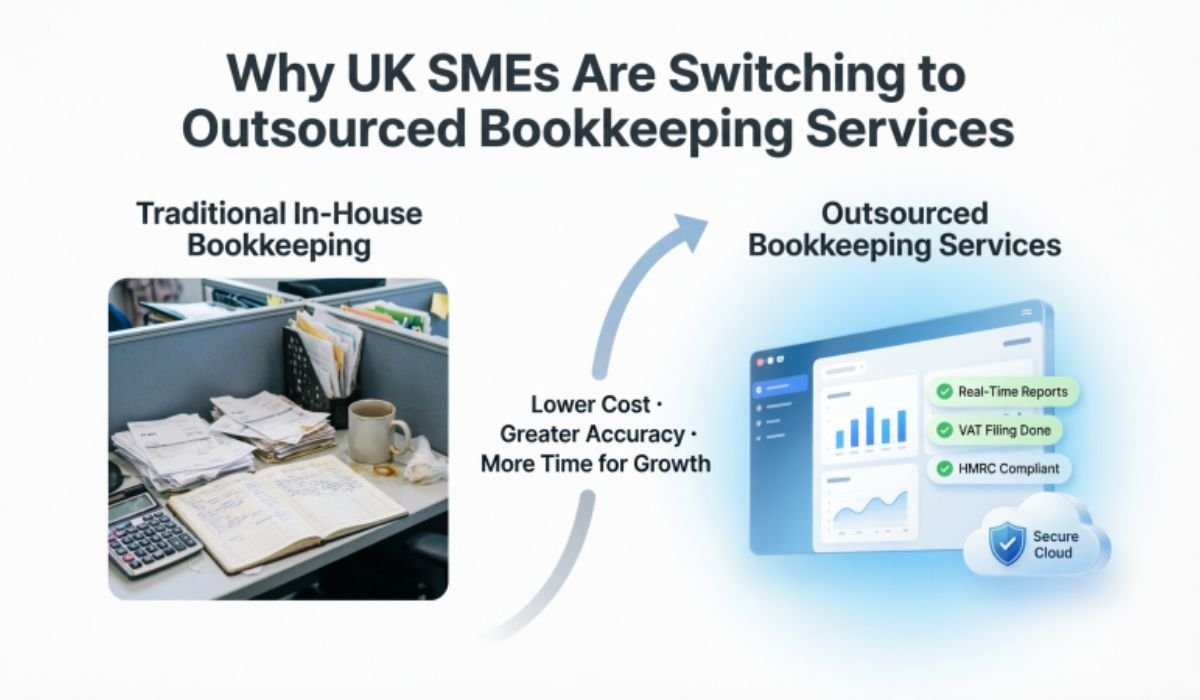
For many UK small business owners, the dream of entrepreneurship often collides with the reality of administrative overwhelm. You started your business to innovate, sell, or provide a specialized service not to spend your Sunday evenings squinting at receipts and trying to reconcile bank statements in an Excel spreadsheet.
Yet, for thousands of SMEs across the country, this is the weekly ritual. The “hidden struggle” of financial management is real: many business owners report spending upwards of 20 hours per week on back-office tasks. This isn’t just “admin time”; it is a massive opportunity cost. While you are chasing a missing VAT invoice or worrying about a looming HMRC deadline, you aren’t focusing on strategy, sales, or your team.
In the current economic climate, bookkeeping is no longer just a necessary evil .It is the foundation of survival and growth. This is exactly why we are seeing a significant shift toward outsourced bookkeeping services in the UK. It is no longer a trend for the tech-savvy; it has become a strategic necessity for any business serious about scaling without the stress.
Why Bookkeeping Has Become a Major Challenge for UK SMEs
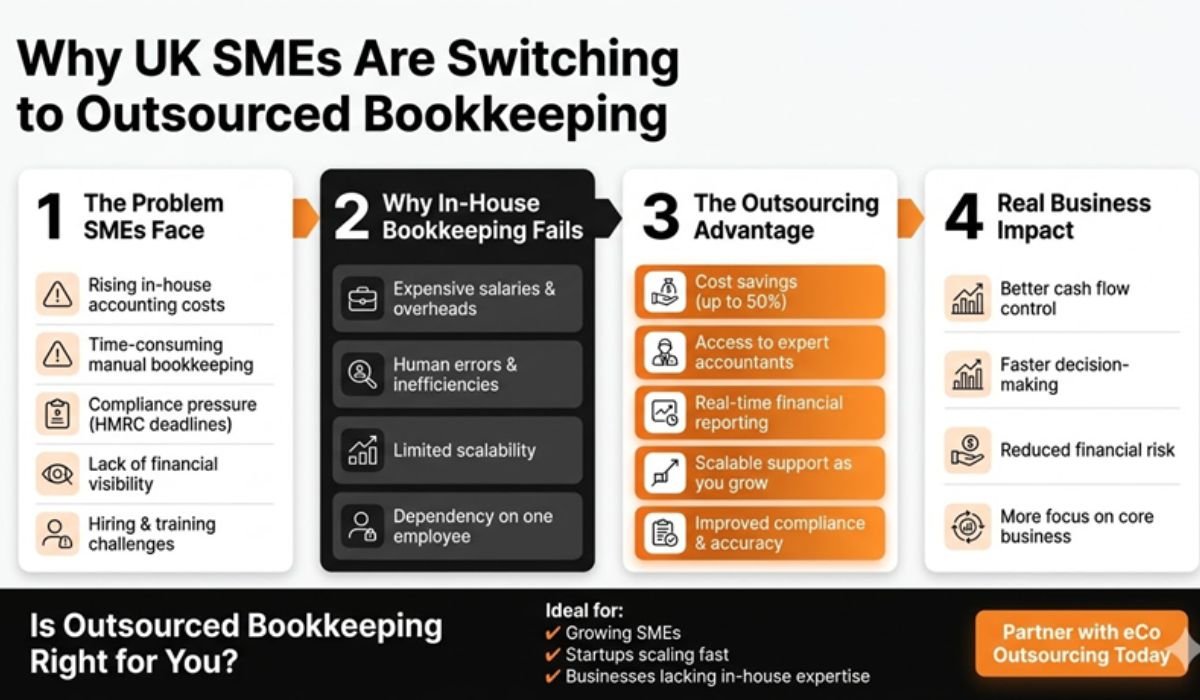
If you feel like managing your business finances has become harder over the last few years, you aren’t imagining it. Several factors have converged to make internal bookkeeping a minefield for the average UK business owner.
Increasing Compliance Pressure (HMRC & Making Tax Digital)
The days of the “shoebox of receipts” are officially over. HMRC’s Making Tax Digital (MTD) initiative has fundamentally changed the landscape. From April 2022, all VAT-registered businesses must keep digital records and use functional compatible software to submit VAT returns. The complexity of VAT, particularly for businesses dealing with imports, exports, or mixed-rate goods, means that a simple mistake can lead to significant penalties.
Rising Cost of Hiring In-House Staff
Finding a skilled, reliable bookkeeper in the UK is becoming increasingly expensive. It isn’t just the salary (which has risen due to inflation and talent shortages); it’s the “fully loaded” cost:
- Employer National Insurance contributions
- Workplace pension contributions
- Holiday pay and sick leave
- Office space and hardware
- Continuous training on changing tax laws
Time Drain and Opportunity Cost
Every hour you spend on bookkeeping is an hour you aren’t spending on “revenue-generating activities.” If your time is worth £100/hour and you spend 10 hours a month on bookkeeping, that’s £1,000 of value lost. If an outsourced service costs a fraction of that, the math makes the decision for you.
Lack of Real-Time Financial Visibility
Many SMEs still operate on “delayed data.” They waited until the end of the quarter to see how they performed. In a fast-moving economy, relying on outdated spreadsheets is like trying to drive a car while looking only in the rearview mirror. Without real-time insights into cash flow, you cannot make informed decisions about hiring, inventory, or investment.
What Are Outsourced Bookkeeping Services?
Before we dive into the benefits, let’s clear up the definition. Outsourced bookkeeping services in the UK involve hiring a professional third-party firm to manage your daily financial records remotely.
It is a comprehensive solution that usually includes:
- Transaction Recording: Categorizing every pound that enters or leaves your accounts.
- Bank Reconciliation: Ensuring your bank balance matches your internal records perfectly.
- VAT Returns: Preparing and filing your digital VAT returns in compliance with MTD.
- Financial Reporting: Generating Balance Sheets and Profit & Loss (P&L) statements.
- Cloud Integration: Using industry-standard tools like Xero, QuickBooks, or Sage to ensure your data is accessible anywhere, anytime.
Why UK SMEs Are Switching to Outsourced Bookkeeping
The transition to outsourcing isn’t just about avoiding a headache; it’s about gaining a competitive edge. Here is why the shift is happening:
1. Significant Cost Savings
When you outsource, you pay for the output, not the hours. You don’t have to worry about NI, pensions, or recruitment fees.
Suppose the annual cost of a part-time in-house bookkeeper is $C_{in}$, and the monthly cost of an outsourced service is $M_{out}$. The annual savings $S$ can be expressed as:
$$S = C_{in} – (12 \times M_{out})$$
In most cases, $S$ represents a saving of 40% to 60% compared to an in-house hire.
2. Time Back for Business Growth
By offloading the “paperwork,” business owners regain their most valuable asset: time. You can spend those 20 hours a month on marketing strategies, improving product quality, or building client relationships.
3. Access to Expertise Without Hiring
When you outsource, you aren’t just getting a data entry clerk; you are getting a team of qualified professionals who live and breathe UK tax compliance. They know the nuances of allowable expenses and HMRC regulations that the average business owner might miss.
4. Improved Accuracy & Reduced Errors
Professional bookkeepers use standardized processes and automated tools to minimize human error. This accuracy doesn’t just provide peace of mind; it prevents costly HMRC fines and interest charges.
5. Scalability as Your Business Grows
If your business doubles in size next month, an in-house bookkeeper might become overwhelmed. An outsourced provider can simply adjust your service level. It is a flexible solution that grows with you.
The Shift: Before vs After Outsourcing
| feature | Before Outsourcing | After Outsourcing |
| Stress Level | High (HMRC deadlines looming) | Low (Deadlines managed by pros) |
| Data Accuracy | Questionable (Manual entries) | High (Automated & Verified) |
| Cash Flow | “Guesswork” | Crystal Clear |
| Weekends | Spent on spreadsheets | Spent with family/resting |
Signs Your Business Needs Outsourced Bookkeeping
How do you know it’s time to make the switch? If any of the following sound familiar, you have likely outgrown your current setup:
- You are behind on VAT filings: You find yourself rushing at the last minute or paying penalties for late submissions.
- You rely heavily on spreadsheets: Excel is great, but it isn’t a dedicated accounting tool and is prone to broken formulas and manual errors.
- You don’t understand your financial reports: You see the numbers, but you don’t know what they mean for your future.
- Bookkeeping is eating your personal time: You are doing the books at 9 PM on a Tuesday.
- Your business is growing, but your finances are messy: Revenue is up, but you aren’t sure where the cash is going.
How Outsourced Bookkeeping Works
One of the biggest hesitations business owners have is the fear that the transition will be complicated. In reality, a professional provider makes the “onboarding” process seamless.
- Initial Consultation: We discuss your current pain points, transaction volume, and business goals.
- Data Migration / Onboarding: We securely transfer your existing data into a modern cloud accounting platform.
- Software Setup: We configure tools like Xero or QuickBooks, setting up automated bank feeds to reduce manual entry.
- Monthly Workflow: You simply snap photos of your receipts (using apps like Dext) or forward digital invoices. We take care of the rest.
- Reporting & Communication: Every month, you receive a clear set of reports and a briefing on your financial health.
How Much Do Outsourced Bookkeeping Services Cost in the UK?
Pricing is generally based on the complexity and volume of your transactions. Unlike a fixed salary, this is a scalable expense.
- Small/Micro Businesses: £150 – £250 per month.
- Growing SMEs: £300 – £600 per month.
- Large/Complex SMEs: £600+ per month.
Factors that affect your quote:
- Transaction Volume: How many invoices and bank lines do we need to process?
- VAT Complexity: Are you on a standard, flat rate, or margin scheme? Do you have international trade?
- Payroll: Do you need us to manage PAYE and pension filings as well?
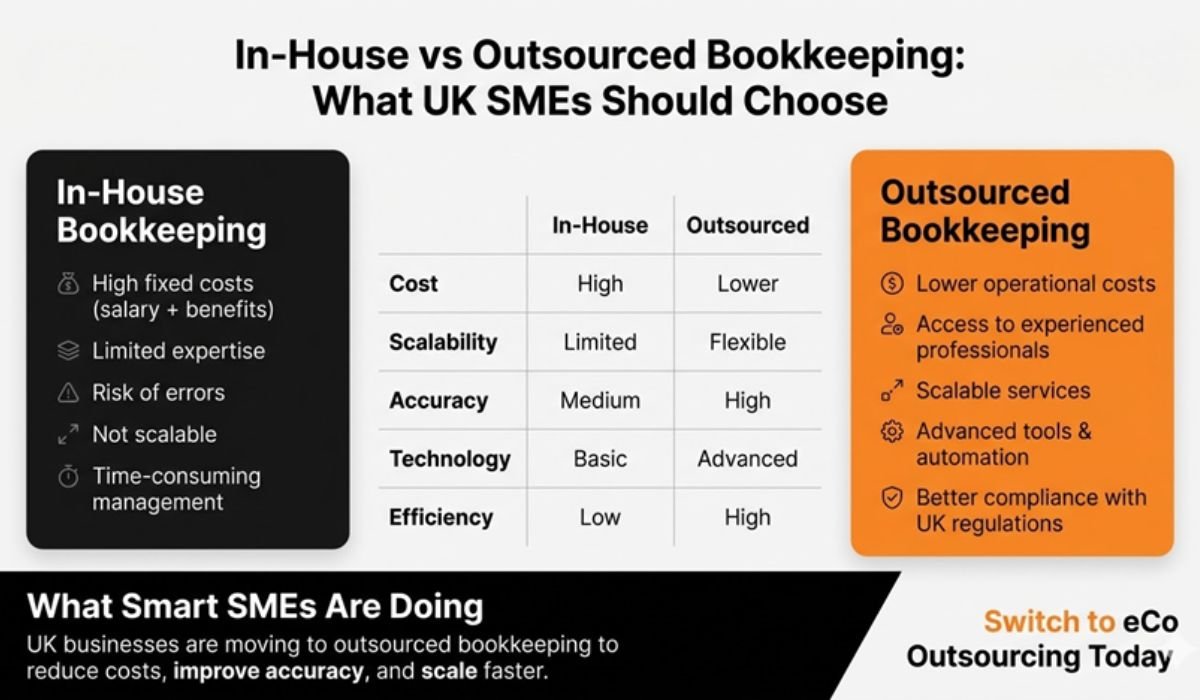
Outsourced vs In-House Bookkeeping
| Factor | In-House | Outsourced |
| Cost | High (Salary + Benefits) | Flexible (Fixed Monthly Fee) |
| Expertise | Limited to one person’s knowledge | Broad (A team of specialists) |
| Scalability | Low (Need to hire/fire) | High (Instant adjustments) |
| Risk | High (Dependency on one person) | Low (Continuity of service) |
| Software | You pay for licenses/updates | Included in the service package |
UK-Based vs Offshore Bookkeeping . What Should You Choose?
While offshore providers can be cheaper, they often come with significant risks for UK SMEs.
- UK-Based Pros: Deep knowledge of HMRC regulations, MTD, and UK GAAP. Communication is easier, and they are in your time zone.
- Offshore Risks: Inconsistency in quality, lack of understanding of specific UK tax nuances, and potential data security
For the sake of compliance and peace of mind, choosing a UK-based provider ensures that the person handling your books actually understands the landscape you are operating in.
Is Outsourced Bookkeeping Safe?
This is a critical concern. Your financial data is the lifeblood of your company. Professional outsourced bookkeeping services in the UK utilize bank-level security.
- GDPR Compliance: As a UK provider, we are strictly governed by data protection laws.
- Access Controls: We use secure, encrypted portals for document sharing.
- Cloud Safety: Platforms like Xero use multi-factor authentication and redundant backups, making them far safer than a local file saved on a laptop.
What Can Go Wrong?
Outsourcing is highly effective, but only if done right. Common pitfalls include:
- Poor Onboarding: If the initial setup is rushed, the data remains messy. Solution: Choose a provider with a clear, structured onboarding phase.
- Miscommunication: Feeling “out of the loop.” Solution: Ensure your provider has a dedicated account manager and regular reporting cycles.
- Hidden Fees: Being charged for every email or phone call. Solution: Look for transparent, fixed-monthly pricing.
When You Should NOT Outsource Bookkeeping
Believe it or not, outsourcing isn’t for everyone.
- Early-Stage Micro Businesses: If you have five transactions a month, you can probably manage it yourself for a while longer.
- Large Corporations: If your operations are so massive that you require a dedicated, 40-hour-a-week finance team on-site, in-house is usually better.
- Lack of Internal Oversight: You cannot simply “abdicate” your responsibility. You still need to review the reports we provide.
Beyond Bookkeeping: Strategic Benefits for UK SMEs
The most successful SMEs don’t just use bookkeeping for compliance; they use it for strategy. When your books are accurate and up-to-date, you gain access to:
- Cash Flow Forecasting: Predicting where your bank balance will be in 3 months.
- Financial Planning: Can you afford that new piece of equipment or that new hire?
- Better Decision-Making: Identifying which of your products or services are actually profitable and which are draining your resources.
Why Choose Eco Outsourcing for Bookkeeping Services in the UK?
At Eco Outsourcing, we specialize in helping UK SMEs move from financial chaos to total clarity. We aren’t just a service provider; we are your financial partners.
- UK Compliance Expertise: We are experts in HMRC, VAT, and MTD.
- Tailored Solutions: We don’t believe in one-size-fits-all. We build a package that fits your transaction volume and goals.
- Dedicated Support: You won’t be talking to a bot; you’ll have a dedicated professional who understands your business.
- Fixed Pricing: No hidden surprises. You know exactly what you are paying every month.
Frequently Asked Questions
- What are the main reasons UK SMEs outsource bookkeeping instead of hiring in-house?
Cost is a major factor hiring a full-time bookkeeper costs £25,000–£35,000 annually plus benefits, training, and software. Outsourced bookkeeping typically costs £150–£500 per month depending on complexity. SMEs also gain access to experienced professionals, cloud-based technology, and scalable support without the burden of recruitment, sick leave, or staff turnover.
- Will I lose control of my finances by outsourcing bookkeeping?
No. With modern cloud-based accounting software like Xero or QuickBooks, you have real-time access to your financial data 24/7. Outsourced bookkeepers keep your records updated, but you retain full visibility and control. Most services provide regular reports, dashboards, and direct communication channels so you’re always informed about your business finances.
- How does outsourced bookkeeping handle Making Tax Digital (MTD) compliance?
Professional outsourced bookkeepers are MTD-compliant and use HMRC-approved software to manage your VAT returns and digital record-keeping. They ensure all submissions are accurate, on time, and meet HMRC’s requirements. This removes the stress of navigating MTD rules yourself and significantly reduces the risk of errors or penalties.
- Is outsourced bookkeeping secure, or could my financial data be at risk?
Reputable outsourced bookkeeping firms use bank-level encryption, secure cloud platforms, and strict data protection protocols compliant with UK GDPR. Your data is often more secure than storing it locally on office computers. Always choose providers with strong security certifications, client references, and clear data protection policies.
- Can outsourced bookkeeping scale with my business as it grows?
Absolutely. That’s one of the biggest advantages. As your transaction volume increases, outsourced providers can scale their services without you needing to hire additional staff or upgrade infrastructure. Whether you’re adding new revenue streams, expanding to multiple locations, or preparing for funding rounds, outsourced bookkeeping adapts to your needs seamlessly.
Conclusion
The Shift Is About Control, Not Just Cost
In the end, the decision to switch to outsourced bookkeeping services in the UK isn’t just about saving a few pounds on salaries . It’s about gaining control.
With Eco Outsourcing, you’re not just delegating tasks. You’re reclaiming your time, gaining clarity over your finances, and building a stronger foundation for growth. You take control of your operations with accurate, real-time financial data. You take control of your decisions with better insights. And most importantly, you take control of your future.
Staying stuck in the DIY bookkeeping loop is one of the fastest ways to limit your business potential and burn out. Partnering with a trusted provider like Eco Outsourcing is how UK SMEs move from reactive firefighting to proactive growth.